

If you’ve started researching biomass boilers, you’ve probably seen the same list of disadvantages repeated over and over:
- They’re expensive.
- They require more maintenance.
- You need somewhere to store fuel.
- Fuel can be difficult to source.
Those are all valid considerations, but they don’t tell the whole story.
In fact, despite these perceived drawbacks, Natural Resources Canada notes that “In recent years, biomass heat has been gaining popularity in remote and rural communities, as well as in commercial and institutional buildings in Canada.” That raises an important question: if biomass has so many disadvantages, why are more businesses choosing it?
After helping businesses evaluate and install biomass heating systems across Canada for more than 15 years, I’ve found that the biggest disadvantage of a biomass boiler isn’t the boiler itself.
It’s the extra research, planning and upfront commitment required before you ever install one.
For the right business, investing that additional time can lead to heating cost reductions of 50–80%, greater long-term energy stability and less dependence on fossil fuels. For the wrong business, however, the extra work and capital investment simply aren’t worth it.
So let’s look at the real disadvantages of biomass boilers from the perspective of someone who helps businesses decide every day whether biomass is actually the right choice.
Biomass Boilers Are Not the Right Fit for Every Application
This is probably the most important point.
Unlike propane or natural gas, I don’t believe biomass is the best solution for every building.
If your heating costs are already low, your annual fuel consumption is small, or there isn’t enough opportunity to save money on fuel, I will often recommend against installing a biomass boiler.
That might sound strange coming from someone who sells biomass heating systems, but the numbers need to make sense.
Some customers are motivated primarily by reducing heating costs. Others want to become more energy independent, move away from fossil fuels or make better use of waste materials produced by their business. Those goals can justify a biomass project even when the financial payback is longer.
The important thing is understanding why you’re considering biomass in the first place.
The Initial Investment Is Higher
There’s no avoiding this one.
A modern automated biomass boiler system generally costs more than a comparable propane or natural gas installation.
Not only is the boiler itself more sophisticated, but you’ll usually need additional infrastructure such as:
- A fuel storage area
- Fuel handling equipment
- Walking floor, agitator, augers or other extraction systems
- Additional planning and installation work
If you simply ask, “How much does a biomass boiler cost for my building?” and compare that number with a propane quote, propane will pretty much always win.
That’s also where many buyers make their biggest mistake.
The Biggest Mistake I See
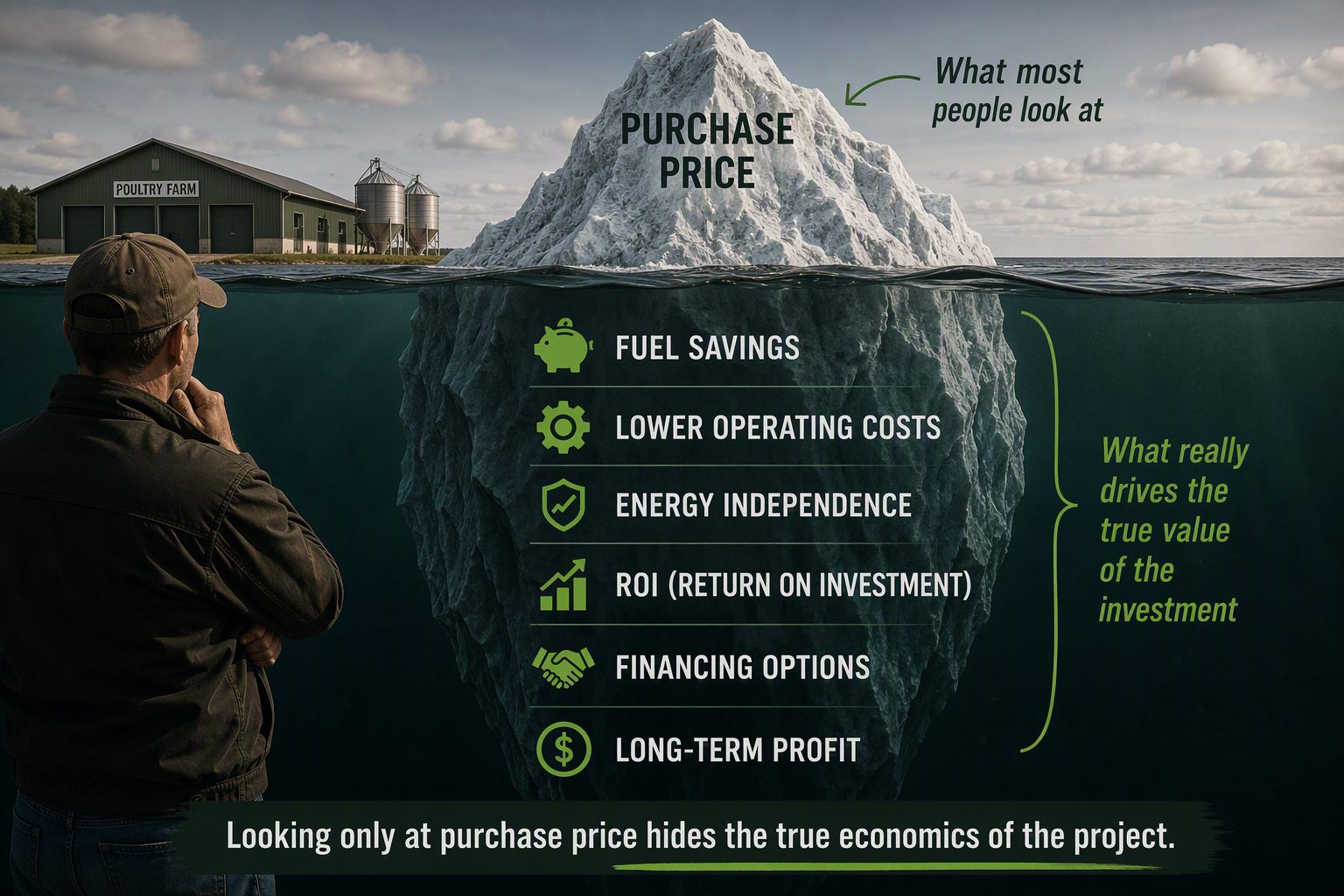
The most common mistake I see is comparing only the initial purchase price.
Take one poultry farmer I’ve worked with.
For years, he has known that locally available woodchips could reduce his heating costs dramatically compared to propane. Even after including the cost of constructing a dedicated boiler building, the entire investment would be paid back in less than five years while reducing annual heating costs by more than 80%.
The project makes financial sense.
What’s holding him back isn’t the economics.
It’s the size of the initial investment with a little “I’m to busy to prioritize this” thrown in.
That’s understandable. Capital is a real consideration for every business.
But modern biomass systems are often financeable. While financing may extend the payback period slightly, the reduction in monthly heating costs can begin immediately.
And time well that’s an issue for most business owners. But if you don’t understand the full benefit then you aren’t seeing the whole picture. Your time and money could be going to projects with much less positive return on your business.
Looking only at purchase price hides the true economics of the project.
Calculating the ROI Takes More Work
This is where biomass differs most from conventional heating.
Installing propane or natural gas is relatively straightforward.
You receive a quote. You estimate future fuel costs. You make your decision.
Biomass requires a much deeper evaluation.
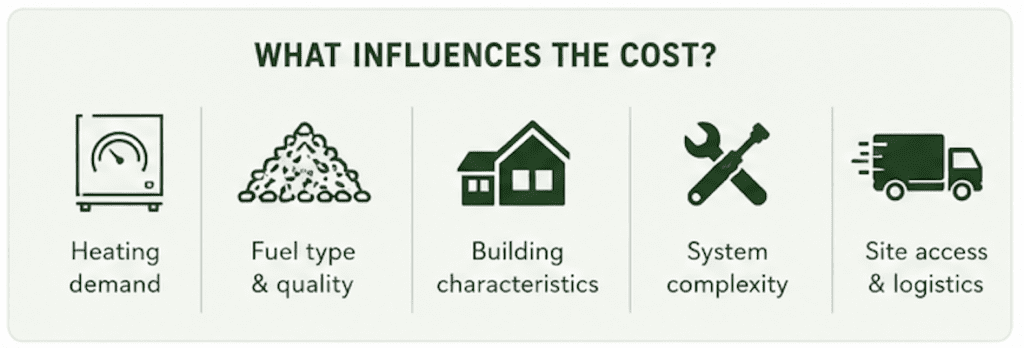
You need to understand:
- Your annual heating demand
- Your fuel options
- Local fuel availability
- Storage requirements
- Fuel handling logistics
- Future fuel pricing
- Available government incentives
- Financing options
It’s more work.
But it’s also why two businesses with similar buildings can have completely different financial outcomes from switching to biomass.
The businesses that invest time into understanding the complete picture are often surprised by how attractive the numbers become.
Fuel Logistics Require Planning
Natural gas arrives through a pipeline. Propane suppliers refill your tank. It’s difficult to imagine anything simpler.
Biomass requires a plan.
- Where will your fuel come from?
- How will it be delivered?
- How much should you store?
- How often will deliveries be needed?
- Will you purchase fuel or produce your own?
These aren’t reasons not to install biomass. They’re simply questions that need answering before you begin.
Once the logistics are properly designed, they become routine.
It Takes More Research Than Buying a Conventional Boiler
This is what I consider to be the real disadvantage of biomass.
Buying a propane boiler is largely a purchase.
Buying a biomass boiler is a project.
You’ll likely spend more time researching manufacturers, understanding fuel quality, evaluating suppliers and planning your installation than you would with any fossil fuel alternative.
Some people simply don’t have the time or interest to do that.
Others discover that the additional planning unlocks opportunities they never expected.
What About Maintenance?
This is probably the biggest concern customers have before installing a biomass boiler.
Many people picture someone constantly feeding wood into a boiler, cleaning ash every day and checking that everything is still working.
That certainly describes older manual wood-fired systems.
It doesn’t describe a modern automated biomass boiler.
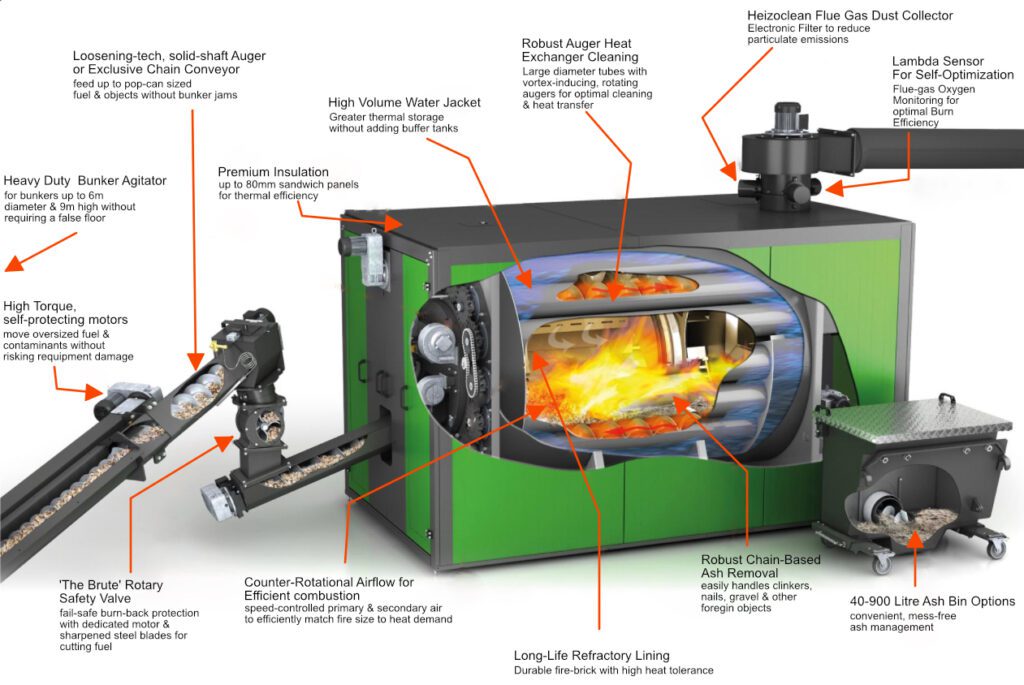
Today’s commercial biomass systems automatically feed fuel, control combustion, clean the heat exchanger and remove ash into an ash container.
Once your fuel supply process has been established, your ongoing involvement is often limited to:
- Refilling the fuel store every week or every few weeks, depending on your application.
- Emptying the ash container periodically.
- Completing routine annual servicing.
The maintenance people worry about before installation is rarely the maintenance they experience afterwards.
A Real Example
One customer operates a pallet manufacturing business.
Initially, they were interested in biomass because they wanted to make productive use of their waste pallets and offcuts.
Their biggest concern wasn’t fuel.
It was reliability.
They were busy running their business and had no interest in hiring someone simply to manage a boiler.
After discussing their concerns, we installed a 300 kW containerized biomass boiler. The complete boiler system and plumbing were housed inside an insulated shipping container positioned beside a dedicated fuel store.
They use a commercial grinder to process their waste wood into clean woodchips. Every couple of weeks they use a loader to refill the fuel store.
The biggest challenge isn’t operating the boiler.
It was establishing a reliable fuel preparation process.
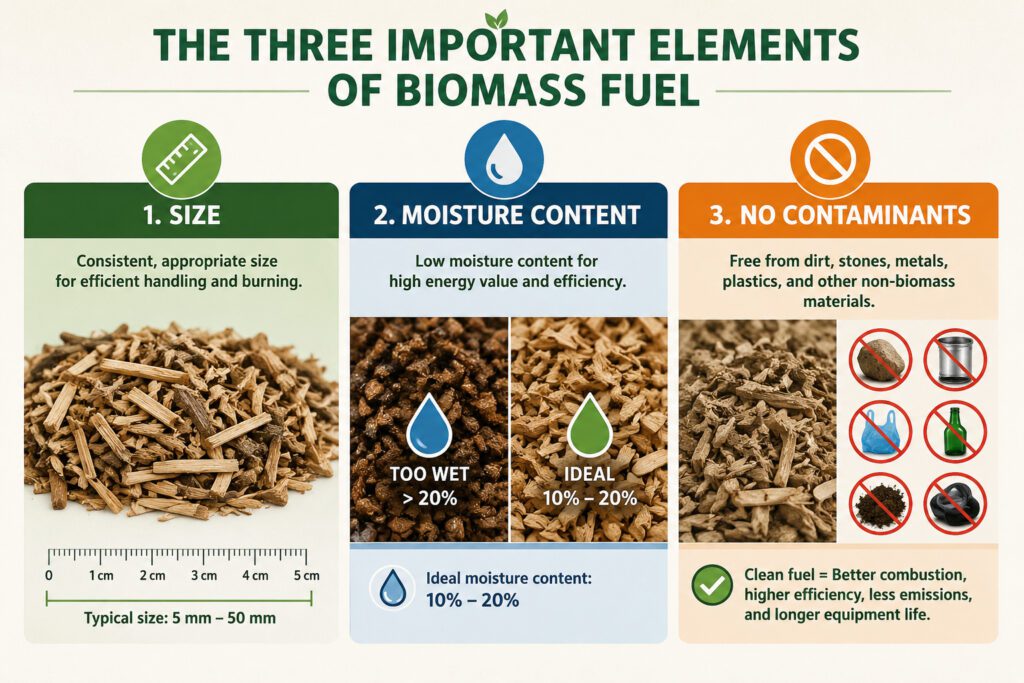
Once they had worked out how to produce consistently clean, dry woodchips and developed a routine for filling the fuel store, the system largely took care of itself.
That’s a story I’ve seen repeated many times.
So What Are the Real Disadvantages of Biomass Boilers?
If someone asked me that question today, my answer would be simple.
Biomass requires more planning, more research and more upfront investment than propane or natural gas.
You need to spend time understanding your fuel source, planning logistics and evaluating whether the economics truly work for your business.
That’s the price of entry.
If you’re unwilling to invest that time, biomass probably isn’t the right choice.
But if you do the research and work with an experienced supplier, the answer often becomes surprisingly clear.
I’ve seen businesses uncover fuel savings they never thought possible, improve their long-term resilience against rising energy prices and gain confidence from having far greater control over one of their largest operating expenses.
And that’s before factoring in the federal government’s 30% Clean Technology Investment Tax Credit now available on biomass heating projects.
Final Thoughts
The biggest disadvantage of a biomass boiler isn’t that it’s difficult to operate.
It’s that it requires more thought before you buy.
Treat it as a business project rather than simply replacing one boiler with another.
Talk to experienced suppliers. (Here is a great place to start: Heizomat Biomass Boilers)
Evaluate your local fuel options.
Run the numbers properly.
Sometimes you’ll discover biomass isn’t the right fit.
Other times, you’ll uncover one of the best long-term investments your business can make.
Here is another article you may be interested in reading: